

In April 2026, the Conservatoire du littoral, a member of the Mediterranean Biodiversity Consortium, carried out a monitoring mission of activities supported by the RESCOM project in the Khenifiss National...
Read moreSurface area:
185,000 ha
Mediterranean Biodiversity Consortium
Surface area:
185,000 ha
Location:
Laâyoune-Sakia and Hamra region in Morocco
Type of natural habitats:
Ocean, coastline, lagoon and desert
Managers:
Agence Nationale des Eaux et Forêts
Protection status
Naïla Lagoon:
1962
Nature Reserve
1980
Ramsar Site
1983
Permanent biological reserve
1996
Site of Biological and Ecological Interest
1998
Inclusion by the Moroccan Directorate of Cultural Heritage on UNESCO’s Tentative List for World Natural Heritage.
The park:
2006
National Park covering the lagoon and desert
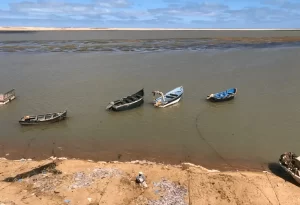
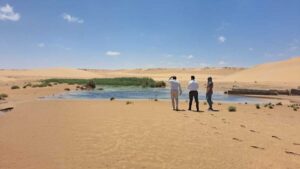
The Khenifiss National Park lies 200km north of Laâyoune, between the towns of Tan Tan and Tarfaya. It covers an area of 185,000 hectares across three rich and important ecosystems: the ocean, a lagoon (Lagune de Naïla) and the desert. Several wadis (“oueds”) and “Sebkhats” used for salt production are also found within the park. The heart of the park lies arround the Naïla lagoon,
classified as a nationally protected area. The lagoon has also been classified as a Ramsar Site since 1980. This area is home to a large number of migratory birds every year (211 species), including 3 species of global importance: the Ruddy Shelduck, the Marbled Teal and the Audoin’s Gull. In 2022, for the first time in 50 years in the Kingdom of Morocco, pink flamingos were observed nesting there.
Regarding human activities, pressure on the lagoon remains relatively low:
RESCOM supports the commitment of park managers and local stakeholders to strengthen the attractiveness of the National Park and to develop ecotourism activities that benefit local communities, thereby further justifying the preservation of species. The project also supports the implementation of ecological restoration operations aimed at encouraging the return of pink flamingos to the nesting area and ensuring successful breeding.
In order to meet these objectives, a number of activities have been set up:
The Khenifiss Park is rich in marine, lagoon, and terrestrial ecosystems, offering remarkable biodiversity—particularly in terms of avifauna—as well as a great diversity of landscapes. All of these environments are integrated into the various activities supported by RESCOM, notably through the different ecotourism initiatives developed with local economic stakeholders such as fishermen and tourism operators. These initiatives address socio-economic challenges while promoting avifauna, marine fauna, the desert hinterland, and local culture.
RESCOM aims to strengthen the socio-economic role of the Khenifiss National Park for local populations and professionals operating within and around the natural area (fishermen, salt producers, nearby restaurant owners and accommodation providers, etc.). Through these socio-economic activities, local, national, and international populations will be made aware of and informed about various issues related to environmental conservation, as well as terrestrial and marine biodiversity. The creation of artificial islets is intended to contribute directly to biodiversity conservation by encouraging the return of pink flamingo nesting within the Kingdom of Morocco.
To monitor the results, tourism monitoring indicators have already been put in place (number of tourists, origin, activities carried out, prices paid, etc.), and future ornithological monitoring will make it possible to assess the impact of the creation of artificial islets on flamingo reproduction.
In April 2026, the Conservatoire du littoral, a member of the Mediterranean Biodiversity Consortium, carried out a monitoring mission of activities supported by the RESCOM project in the Khenifiss National...
Read moreThe Mediterranean Biodiversity Consortium, represented by the Conservatoire du littoral and Tour du Valat, was in Morocco last week to support the Agence Nationale des Eaux et Forêts in promoting...
Read more